

Electric vehicles (EVs) are rapidly gaining popularity around the world. People are choosing EVs because they are eco-friendly, cost-effective, and require less maintenance compared to petrol or diesel cars. However, one of the most common questions is: how long does it take to charge an electric car?
Unlike traditional vehicles, EVs don’t refuel at petrol pumps—they recharge their batteries using electricity. The charging time depends on several factors such as the type of charger, battery size, current charge level, and environmental conditions. In this article, we will explain everything about EV charging time in very simple English, covering all important aspects, including home charging, public stations, costs, and the situation in Pakistan.
What Determines EV Charging Time?
The charging time of an Electric Vehicle (EV) depends on several key factors, including battery size, charger type, and power output. Larger batteries take longer to charge, while fast chargers can significantly reduce waiting time. The EV Charging Levels — Level 1, Level 2, and DC Fast Charging — play a major role in how quickly your vehicle recharges. Additionally, temperature, vehicle model, and the state of battery charge also affect performance. Understanding these factors helps drivers choose the right charging method and plan efficient trips, ensuring a smooth and time-saving EV charging experience. To better understand charging variations, it’s also important to know what type of electric car are there, as different EV models have unique battery capacities and charging requirements.
The time it takes to charge an EV is not the same for every car. It depends on:
- Battery Capacity (kWh)
- Larger batteries store more energy and take longer to charge. For example, a Tesla Model S with a 100 kWh battery will take longer than a Nissan Leaf with a 40 kWh battery.
- Larger batteries store more energy and take longer to charge. For example, a Tesla Model S with a 100 kWh battery will take longer than a Nissan Leaf with a 40 kWh battery.
- Charger Power (kW)
- Higher power chargers deliver more electricity to the battery, reducing charging time. A Level 1 home socket delivers less power than a DC fast charger.
- Higher power chargers deliver more electricity to the battery, reducing charging time. A Level 1 home socket delivers less power than a DC fast charger.
- State of Charge (SOC)
- The current battery level matters. Charging from 20% to 80% may be faster than 0% to 100%, as the charging speed slows down as the battery fills.
- The current battery level matters. Charging from 20% to 80% may be faster than 0% to 100%, as the charging speed slows down as the battery fills.
- Temperature and Environment
- Extremely cold or hot temperatures can reduce charging efficiency. Some EVs have battery heating or cooling systems to maintain optimal charging speed.
- Extremely cold or hot temperatures can reduce charging efficiency. Some EVs have battery heating or cooling systems to maintain optimal charging speed.
- Battery Age and Health
- Older batteries may not accept electricity as quickly as new ones, slightly increasing charging time.
- Older batteries may not accept electricity as quickly as new ones, slightly increasing charging time.
Types of EV Charging and Typical Times to Charge an Electric Car
EV charging is divided into three main levels, each with different speeds and uses:
1. Level 1 Charging
- Uses a regular household socket (120V).
- Very slow, typically adding 5–8 km of range per hour.
- Best for overnight charging at home.
- Ideal for drivers with short daily commutes.
2. Level 2 Charging
- Uses a 240V wallbox or public charger.
- Faster than Level 1, adding 20–40 km of range per hour.
- Common in homes, offices, and shopping malls.
- Allows full charging overnight or in a few hours.
3. DC Fast Charging (Level 3)
- Ultra-fast charging using direct current (DC).
- Can charge 80% of the battery in 30–60 minutes.
- Found on highways and public charging hubs.
- Perfect for long trips or when you need a quick top-up.
Factors That Affect EV Charging Speed
Even with a fast charger, charging time can vary due to:
- Battery Size: Bigger batteries naturally take longer to fill.
- Charger Power Output: More powerful chargers reduce time.
- Temperature: Cold or very hot weather can slow charging efficiency.
- State of Charge: Charging slows down as the battery approaches full capacity.
- Battery Health: Older batteries may not charge as efficiently.
How to Reduce EV Charging Time
Charging an electric vehicle (EV) can be faster and more efficient if you follow these tips:
- Use a Faster Charger – Level 2 or DC fast chargers significantly reduce charging time compared to a standard home socket.
- Avoid Extreme Battery Levels – Charging from 20% to 80% is quicker and better for battery health than charging 0% to 100%.
- Precondition the Battery – In cold weather, preheating the battery helps maintain optimal charging speed.
- Install a High-Power Home Charger – Upgrading to a high-capacity home charger saves hours over a standard socket.
- Schedule Charging During Off-Peak Hours – Smart chargers can optimize electricity usage and sometimes charge faster.
By following these tips, EV owners can save time, protect battery health, and enjoy efficient charging every day.
Home Charging vs Public Charging
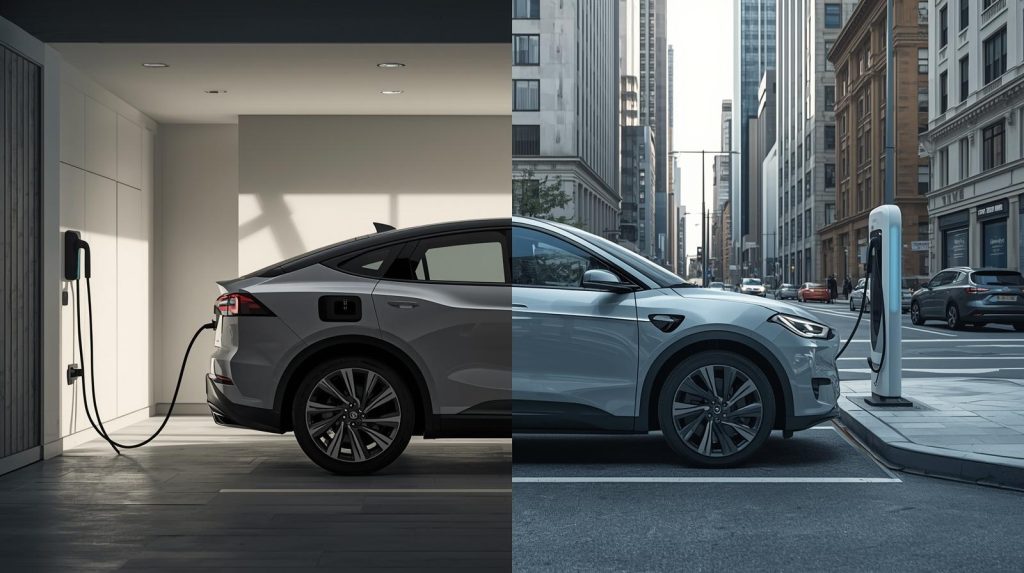
EV owners can charge at home or use public charging stations. Both have advantages and disadvantages:
| Charging Option | Typical Time | Cost | Convenience |
| Home Charging | 6–12 hours (Level 1/2) | Cheaper | Convenient for overnight charging |
| Public Fast Charging | 30–60 minutes (DC fast) | More expensive | Ideal for long trips and emergencies |
Home charging is perfect for daily commutes, while public chargers are necessary for long-distance travel or quick top-ups.
Charging Times of Popular EV Models
Charging time varies depending on the EV model and charger type. Here are some common examples:
- Tesla Model 3 – 30–50 minutes using a DC fast charger.
- Nissan Leaf – 40–60 minutes on a DC fast charger.
- MG ZS EV (Pakistan) – 6–8 hours using a Level 2 home charger.
- Audi e-tron – 30–45 minutes with a DC fast charger.
Knowing the charging times of popular EVs helps owners plan trips, choose the right charger, and understand what to expect for daily and long-distance use.
Common Myths About EV Charging
Many people have misconceptions about charging electric vehicles (EVs). Here are some common myths:
- EVs take too long to charge – Modern fast chargers can charge 80% of a battery in 30–60 minutes.
- Fast charging damages the battery – EVs are designed to handle fast charging safely.
- You must fully charge the battery every time – Partial charging (20%–80%) is safe and efficient.
- Charging is expensive – Home charging is often cheaper than filling petrol or diesel cars.
Understanding the facts helps EV owners charge their vehicles efficiently, safely, and cost-effectively.
EV Charging Infrastructure in Pakistan
Electric vehicle (EV) charging infrastructure in Pakistan is growing steadily.
- Current Availability – Charging stations are mainly in Islamabad, Lahore, and Karachi.
- Public and Private Support – Companies like MG, Audi, and BYD are helping expand charging networks.
- Government Initiatives – Policies are being introduced to encourage EV adoption, reduce import duties, and support new charging stations.
As infrastructure improves, EV owners in Pakistan will have more convenient, faster, and reliable charging options, making electric vehicles a practical choice for daily use.
Future of EV Charging
The future of electric vehicle (EV) charging is bright and full of innovation:
- Ultra-Fast Charging – Batteries could be fully charged in just 5–10 minutes.
- Wireless Charging – Cars may charge automatically when parked over a charging pad, without cables.
- Solar-Powered Charging – Clean, renewable energy will power EVs, reducing environmental impact.
- Vehicle-to-Grid (V2G) Technology – EVs can send electricity back to the grid, supporting energy supply.
These advancements will make EV charging faster, more convenient, and eco-friendly, encouraging more people to switch to electric vehicles.
FAQs
Q1. How long does it take to charge a fully empty EV?
- Level 1: 8–20 hours, Level 2: 4–8 hours, DC fast: 30–60 minutes.
Q2. Can I charge my EV using a regular household socket?
- Yes, but it will be slow (Level 1 charging).
Q3. Does fast charging damage the battery?
- No, modern EVs are designed to handle fast charging safely.
Q4. How long does it take to charge an EV at home?
- Typically 6–12 hours using Level 1 or Level 2 chargers.
Q5. Is EV charging cheaper than petrol?
- Yes, home charging is much cheaper than filling a petrol or diesel tank.
Conclusion
So, how long does it take to charge an electric car? It depends on battery size, charger type, and environmental conditions. Home charging is convenient and cost-effective, while public fast chargers allow quick top-ups for long trips.
In Pakistan, EV charging infrastructure is still growing, but with government support and private investment, it will soon be as convenient as refueling petrol vehicles. Understanding charging times helps EV owners plan their trips efficiently and encourages more people to adopt electric vehicles as a clean, affordable, and sustainable transportation solution.