

As electric vehicles (EVs) become more popular, many drivers want to understand the Pros and Cons of Slow vs. Fast Charging for EV Car Batteries. Charging speed affects battery health, convenience, electricity costs, and long-term ownership experience.
Some EV owners prefer slow overnight charging at home, while others rely on fast public chargers for road trips. But which option is better? The answer depends on your driving habits, battery technology, and charging needs.
In this detailed guide, we’ll explore the Pros and Cons of Slow vs. Fast Charging for EV Car Batteries in simple, easy-to-understand language so you can make the right decision for your EV.
Understanding Slow Charging vs. Fast Charging
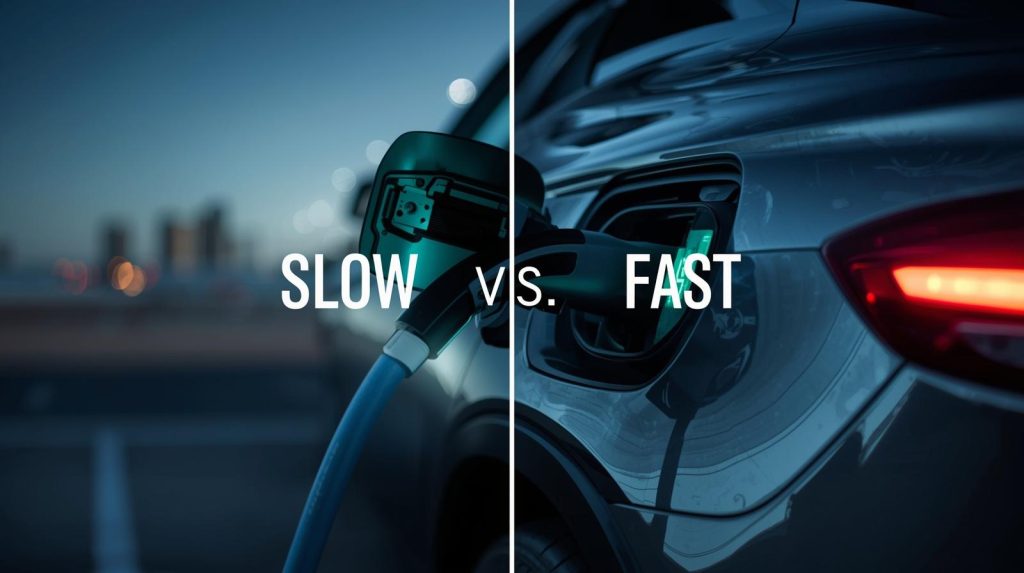
Before comparing advantages and disadvantages, let’s clarify what each term means.
What Is Slow Charging?
Slow charging usually refers to:
- Level 1 charging (120V outlet)
- Level 2 charging (240V home charger)
This method uses AC (alternating current) and typically charges your EV over several hours.
Most home charging falls into this category.
What Is Fast Charging?
Fast charging usually refers to:
This method uses direct current (DC) and can charge your battery from 20% to 80% in about 20–40 minutes, depending on the vehicle and charger.
Fast charging is commonly used at highway stations and public charging networks.
Pros of Slow Charging for EV Car Batteries
When discussing the Pros and Cons of Slow vs. Fast Charging for EV Car Batteries, slow charging offers several important advantages.
1. Better for Long-Term Battery Health
Slow charging generates less heat. Since excessive heat can accelerate battery degradation, slower charging is generally considered gentler on lithium-ion batteries.
Most EV manufacturers recommend regular slow charging for daily use.
2. Lower Cost
Charging at home — especially during off-peak hours — is usually cheaper than public fast charging.
Electricity rates are often lower at night, and smart chargers allow you to schedule charging for maximum savings.
3. Convenient for Daily Driving
If you charge overnight, your EV is ready every morning with minimal effort. For drivers with predictable routines, slow charging is ideal.
4. Less Stress on Electrical Infrastructure
Slow charging places less strain on:
- Your home’s electrical system
- The public power grid
This makes it more sustainable for everyday use.
Cons of Slow Charging
While slow charging has many benefits, there are also downsides.
1. Long Charging Time
The biggest drawback is time.
A full charge can take:
- 8–12 hours with Level 2
- 20+ hours with Level 1
This can be inconvenient if you need a quick recharge.
2. Not Ideal for Long Trips
If you’re traveling long distances, slow charging is impractical. Waiting several hours during a road trip is simply not realistic.
Pros of Fast Charging for EV Car Batteries
Now let’s examine the advantages of fast charging in the Pros and Cons of Slow vs. Fast Charging for EV Car Batteries discussion.
1. Extremely Convenient for Travel
Fast charging is perfect for:
- Road trips
- Emergency charging
- Busy schedules
You can add hundreds of miles of range in under an hour.
2. Expanding Charging Networks
Public fast-charging infrastructure is growing rapidly. Many highways now have multiple DC fast-charging stations, making long-distance travel easier than ever.
3. Time-Saving
For drivers who can’t charge at home — such as apartment residents — fast charging may be the most practical solution.
Cons of Fast Charging
Despite its convenience, fast charging has some disadvantages.
1. Potential Battery Degradation Over Time
Frequent fast charging generates more heat, which can accelerate battery wear if used excessively.
Modern EV battery management systems help reduce this risk, but regular reliance on fast charging may slightly shorten battery lifespan over many years.
2. Higher Cost
Public DC fast charging is typically more expensive per kilowatt-hour than home charging.
While convenient, it can increase your overall charging expenses.
3. Charging Speed Slows After 80%
Fast charging is most efficient between 20% and 80% battery level. After 80%, the charging speed slows significantly to protect battery health.
This means you may not always get a full charge quickly.
Impact on Battery Health: What Experts Say
When evaluating the Pros and Cons of Slow vs. Fast Charging for EV Car Batteries, research shows:
- Occasional fast charging does not significantly harm modern EV batteries.
- Regular slow charging is ideal for daily use.
- Battery management systems regulate temperature and charging speed to protect longevity.
Most EV manufacturers design batteries to last 8–15 years under normal charging habits.
Which Charging Method Is Best for You?
The best approach depends on your lifestyle.
Choose Slow Charging If:
- You charge at home overnight
- You want maximum battery longevity
- You want lower charging costs
- You have predictable daily driving habits
Choose Fast Charging If:
- You travel long distances frequently
- You live in an apartment without home charging
- You need quick energy top-ups
The Ideal Strategy: A Balanced Approach
Most EV experts recommend:
- Use slow charging for daily needs
- Use fast charging for road trips and emergencies
This balanced approach minimizes battery stress while maintaining convenience.
The Future of EV Charging
Technology continues to improve:
- Faster chargers with better heat management
- Advanced battery chemistries
- Improved thermal regulation systems
- Smarter charging algorithms
Future EV batteries will likely handle fast charging even better than today’s models.
Conclusion: Pros and Cons of Slow vs. Fast Charging for EV Car Batteries
Understanding the Pros and Cons of Slow vs. Fast Charging for EV Car Batteries helps you protect your investment and improve your driving experience.
Slow Charging:
Better for battery health
Lower cost
Ideal for daily use
Takes longer
Fast Charging:
Extremely convenient
Essential for road trips
Saves time
More expensive
May slightly increase battery wear if used constantly
In most cases, the smartest strategy is simple: slow charge daily, fast charge occasionally.
With proper charging habits, modern EV batteries are built to last many years — giving you reliable, efficient, and eco-friendly transportation for the long term.
By understanding the real Pros and Cons of Slow vs. Fast Charging for EV Car Batteries, you can confidently choose the charging method that fits your lifestyle and protects your vehicle’s battery health.
FAQs: Pros and Cons of Slow vs. Fast Charging for EV Car Batteries
1. What is the difference between slow and fast charging for EV car batteries?
Slow charging typically uses AC power through Level 1 or Level 2 chargers and takes several hours to fully charge an EV. Fast charging, often referred to as DC fast charging, delivers high-power DC electricity directly to the battery and can charge an EV up to 80% in 20–60 minutes, depending on the vehicle and charger capacity.
2. Is slow charging better for EV battery health?
Yes, in most cases, slow charging is better for long-term EV battery health. Lower charging speeds generate less heat and reduce stress on battery cells, which may help extend the lifespan of lithium-ion batteries.
3. Does fast charging damage EV batteries?
Fast charging does not immediately damage EV batteries, but frequent use of DC fast chargers may accelerate battery degradation over time due to increased heat and higher current flow. Most modern EVs have advanced battery management systems (BMS) to reduce this risk.
4. When should I use fast charging instead of slow charging?
Fast charging is ideal for:
- Long road trips
- Emergency situations
- When you need a quick top-up
Slow charging is better for:
- Overnight home charging
- Daily commuting needs
- Maximizing battery lifespan
5. Is slow charging more cost-effective than fast charging?
Yes, slow charging—especially home charging during off-peak hours—is generally more affordable. Public DC fast charging stations often cost more per kWh due to infrastructure and operational expenses.
6. How long does slow charging take compared to fast charging?
- Slow charging (Level 1): 8–24 hours
- Level 2 charging: 4–8 hours
- DC fast charging: 20–60 minutes for 0–80%
Charging time depends on battery size, charger output, and vehicle model.
7. Can I rely only on fast charging for my EV?
While it is possible, relying solely on fast charging is not recommended for long-term battery health. A balanced approach—using slow charging for daily needs and fast charging when necessary—is considered ideal.
8. Does charging speed affect EV range?
Charging speed itself does not affect total range. However, frequent fast charging may gradually reduce battery capacity over time, which can impact driving range in the long run.