
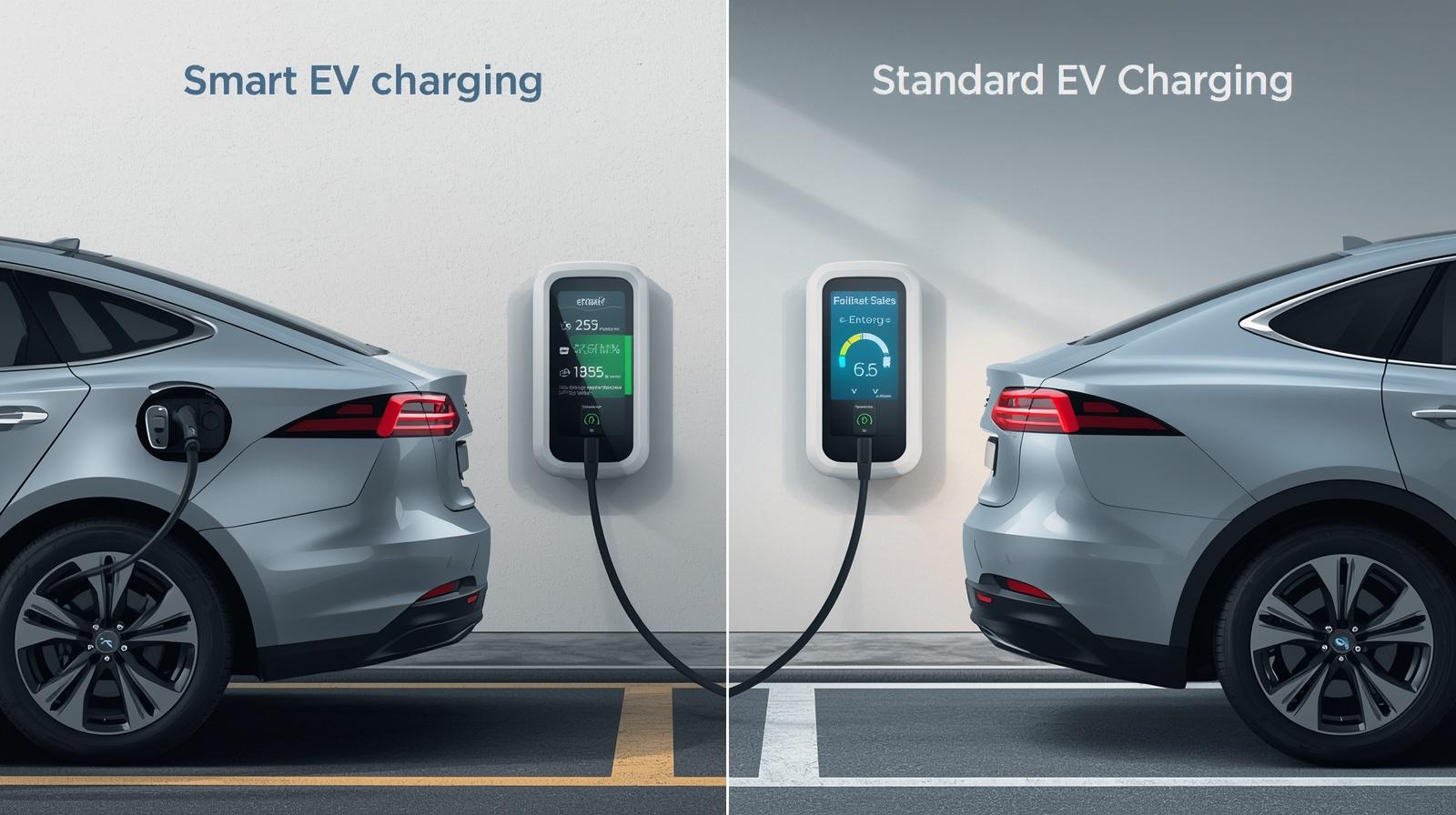
As electric vehicles (EVs) become more common worldwide, charging technology is evolving rapidly. Many EV owners now face an important question: Smart EV charging vs standard EV charging — which one is better?
Understanding the difference between smart EV charging and standard EV charging is essential for making the right decision for your home, workplace, or fleet. The way you charge your EV impacts your electricity bills, battery health, grid stability, and even the environment.
In this detailed guide, we’ll explore smart EV charging vs standard EV charging, compare their features, benefits, and limitations, and help you decide which option is right for you.
What Is Standard EV Charging?
Standard EV charging refers to traditional charging systems that begin supplying power immediately when the vehicle is plugged in. There is no communication with the power grid or automatic optimization.
Key Characteristics of Standard EV Charging
- Starts charging instantly after plugging in
- No real-time communication with utility providers
- Limited scheduling options
- No load balancing
- Basic safety features
Standard chargers are commonly used in:
- Basic home installations
- Older charging units
- Some small businesses
They are simple, functional, and affordable — but lack advanced features.
What Is Smart EV Charging?
Smart EV charging is an advanced charging system that uses communication technology, software, and automation to optimize charging.
Unlike standard charging, smart charging systems can:
- Communicate with the electricity grid
- Schedule charging during off-peak hours
- Adjust charging speed automatically
- Monitor energy usage
- Integrate with renewable energy
- Support vehicle-to-grid (V2G) systems
This intelligent system ensures that energy is used efficiently and cost-effectively.
Smart EV Charging vs Standard EV Charging: Core Differences
To better understand smart EV charging vs standard EV charging, let’s compare them side by side.
| Feature | Standard EV Charging | Smart EV Charging |
|---|---|---|
| Automatic Scheduling | Limited | Advanced |
| Grid Communication | No | Yes |
| Energy Monitoring | Basic | Real-time tracking |
| Cost Optimization | No | Yes |
| Renewable Integration | No | Yes |
| Load Balancing | No | Yes |
| Future-Ready | Limited | Highly scalable |
This comparison clearly highlights why smart charging is gaining popularity globally.
1. Cost Efficiency
One of the biggest differences in smart EV charging vs standard EV charging is cost control.
Standard Charging
- Charges immediately, even during peak hours
- May result in higher electricity bills
- No optimization based on pricing
Smart Charging
- Schedules charging during off-peak hours
- Takes advantage of time-of-use tariffs
- Reduces peak demand charges
For households with variable electricity pricing, smart charging can significantly reduce monthly costs.
2. Impact on the Power Grid
As EV adoption grows — driven by manufacturers like Tesla, Nissan, BMW, and Hyundai — grid management becomes increasingly important.
Standard Charging
If multiple EVs charge at the same time (especially in the evening), it can strain the local grid.
Smart Charging
- Balances demand
- Shifts charging to off-peak hours
- Prevents transformer overload
- Enhances grid stability
Smart charging plays a key role in preventing infrastructure stress.
3. Battery Health Considerations
Charging behavior impacts battery longevity.
Standard Charging
- Charges at full power immediately
- No dynamic adjustment
- May not optimize charging speed
Smart Charging
- Adjusts charging speed when needed
- Reduces unnecessary high-power charging
- Helps maintain optimal battery temperature
Although both methods are safe, smart charging can provide better long-term battery management.
4. Renewable Energy Integration
Another major difference in smart EV charging vs standard EV charging is renewable energy compatibility.
Standard Charging
- Cannot align charging with solar or wind production
- May rely more on fossil-fuel-heavy grid periods
Smart Charging
- Charges when solar production is high
- Absorbs excess wind energy
- Supports clean energy transition
For eco-conscious EV owners, smart charging offers a more sustainable solution.
5. Convenience and User Experience
Standard EV Charging
- Plug in and charge
- Minimal app functionality
- Limited control
Smart EV Charging
- Mobile app control
- Remote monitoring
- Charging notifications
- Energy usage reports
- Custom charging schedules
Smart charging offers greater flexibility and transparency.
6. Installation and Cost Differences
Standard Chargers
- Lower upfront cost
- Simpler installation
- Fewer software features
Smart Chargers
- Slightly higher initial cost
- Requires internet connectivity
- Software updates and app integration
Although smart chargers cost more initially, long-term savings often outweigh the investment.
7. Business and Fleet Benefits
For businesses and fleet operators, the difference between smart EV charging vs standard EV charging is even more significant.
Standard Charging for Fleets
- Risk of simultaneous peak charging
- Higher operational costs
- Limited monitoring
Smart Charging for Fleets
- Load balancing across vehicles
- Reduced peak demand charges
- Detailed energy analytics
- Automated charging management
Smart charging is especially valuable for commercial EV operations.
8. Future-Readiness and Vehicle-to-Grid (V2G)
Smart charging supports emerging technologies such as Vehicle-to-Grid (V2G), where EVs can send electricity back to the grid during peak demand.
Standard charging systems typically lack this capability.
As energy systems become more interconnected, smart charging provides better long-term compatibility.
Which Is Better: Smart EV Charging or Standard EV Charging?
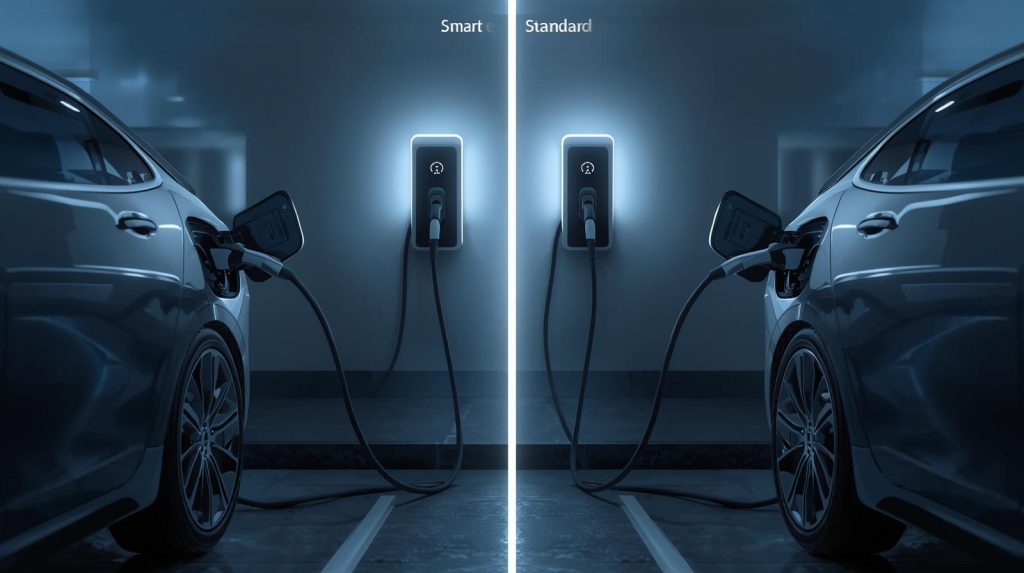
The answer depends on your needs.
Choose Standard EV Charging If:
- You want a lower upfront cost
- You have fixed electricity pricing
- You prefer simple plug-and-play functionality
Choose Smart EV Charging If:
- You want to reduce electricity bills
- You live in an area with time-of-use tariffs
- You use rooftop solar panels
- You own multiple EVs
- You want detailed charging data
- You want a future-ready solution
For most modern EV owners, smart charging provides more advantages.
Environmental Impact Comparison
Smart charging contributes to:
- Reduced peak fossil fuel use
- Better renewable energy utilization
- Lower overall emissions
Standard charging does not actively support grid decarbonization.
If sustainability is important to you, smart charging is the better choice
Conclusion: Smart EV Charging vs Standard EV Charging
When comparing smart EV charging vs standard EV charging, the differences are clear.
Standard charging is simple and functional. It works well for basic needs but lacks optimization.
Smart EV charging, on the other hand, offers:
- Lower long-term costs
- Improved grid stability
- Renewable energy support
- Enhanced battery management
- Better user control
- Future-ready technology
While smart chargers may require a slightly higher initial investment, their long-term benefits make them the smarter choice for most EV owners.
As EV adoption continues to rise globally, smart charging will likely become the new standard rather than the exception.
FAQs: Smart EV Charging vs Standard EV Charging
1. What is the difference between smart EV charging and standard EV charging?
Standard EV charging starts immediately when plugged in and has limited control features. Smart EV charging uses communication technology to schedule, monitor, and optimize charging based on grid demand and electricity pricing.
2. Is smart EV charging more expensive than standard charging?
Smart chargers usually have a higher upfront cost, but they can reduce long-term electricity bills by charging during off-peak hours and optimizing energy use.
3. Does smart EV charging help lower electricity bills?
Yes. Smart EV charging can automatically schedule charging when electricity rates are lower, helping EV owners save money over time.
4. Is standard EV charging safe?
Yes. Standard EV charging is safe when installed properly, but it lacks advanced optimization and load-balancing features found in smart chargers.
5. Can smart EV charging improve battery life?
Smart charging can help reduce unnecessary high-power charging and manage charging speeds, which may support better long-term battery health.
6. Does smart EV charging support renewable energy?
Yes. Smart charging can align EV charging with solar or wind energy production, making it more environmentally friendly.
7. Which is better for home use: smart or standard EV charging?
For most homeowners, smart EV charging is better due to cost savings, convenience, and future-ready features. However, standard charging may be suitable for basic needs.
8. Do businesses benefit more from smart EV charging?
Yes. Businesses and fleet operators can use smart charging to manage multiple vehicles, reduce peak demand charges, and monitor energy usage efficiently.
9. Does smart EV charging require internet access?
Most smart EV chargers require Wi-Fi or internet connectivity to enable remote monitoring, scheduling, and grid communication features.
10. Is smart EV charging the future of EV infrastructure?
Yes. As EV adoption grows, smart EV charging is expected to become the standard due to its efficiency, grid support, and sustainability benefits.