

Introduction
The automotive industry is undergoing a massive transformation, and Electric Vehicles (EVs) are leading the way. As climate change, rising fuel costs, and air pollution challenge global sustainability, the shift from internal combustion engine (ICE) cars to electric mobility is becoming more urgent. Electric vehicles are no longer futuristic concepts—they are here, rapidly growing in popularity, and reshaping how we think about transportation.
But what exactly is an electric vehicle, how does it work, what are its types, and why is it considered the future of mobility? Let’s dive into a comprehensive guide.
What is an Electric Vehicle (EV)?
An Electric Vehicle (EV) is any type of automobile that runs on electricity rather than gasoline or diesel. The working of an electric vehicle involves using electric motors powered by rechargeable battery packs instead of a combustion engine. This makes EVs significantly cleaner, more efficient, and quieter compared to traditional vehicles.
EVs can be charged at home, at public charging stations, or via fast-charging networks, depending on the model and available infrastructure.
In simple words, an electric vehicle replaces fuel tanks with batteries and engines with motors.
How Do Electric Vehicles Work?
Electric vehicles (EVs) work by using an electric motor powered through energy stored in rechargeable batteries. Instead of burning fuel like traditional cars, EVs draw electricity from the battery and convert it into motion. When the driver presses the accelerator, the motor instantly delivers power to the wheels, giving smooth and quick acceleration.
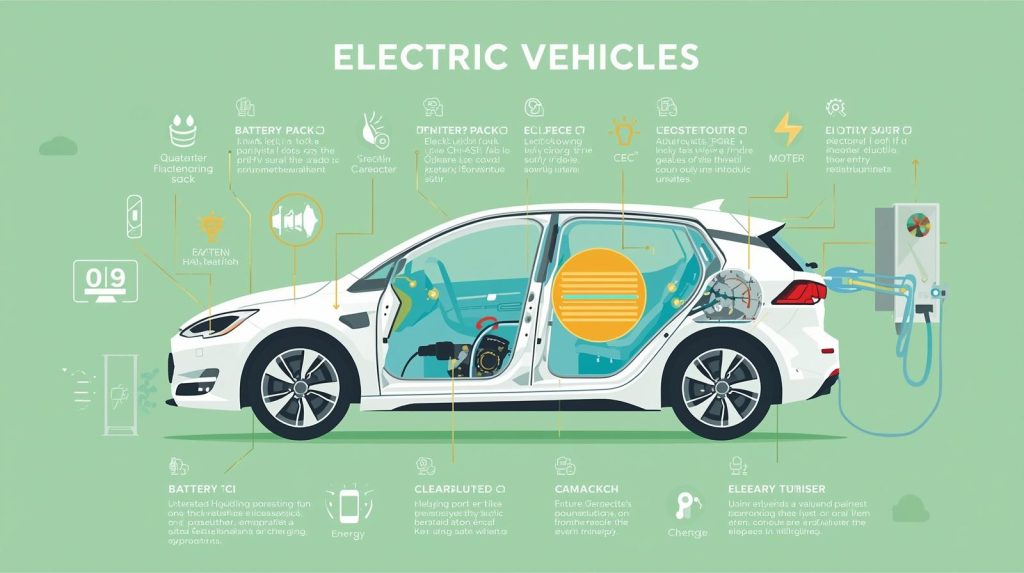
Most EVs also use regenerative braking, which saves energy by sending power back to the battery when the brakes are applied. This makes EVs more efficient, eco-friendly, and cost-saving compared to gasoline cars.
The operation of an electric vehicle may sound complicated, but the mechanism is simpler than that of traditional cars. Here’s how it works:
- Battery Pack – Stores electricity, just like the battery in your phone, but much larger.
- Electric Motor – Converts electrical energy into mechanical energy to move the car.
- Power Electronics – Manage the flow of energy between the battery and the motor.
- Charging System – Allows the EV to be recharged from an external power source.
- Regenerative Braking – Captures and stores energy back into the battery when braking.
When you press the accelerator, electricity flows from the battery to the motor, generating instant torque for smooth and fast acceleration. This is why EVs feel more responsive compared to gasoline cars.
Types of Electric Vehicles
Electric vehicles are not all the same. They are classified into four main types, depending on how they use electricity and fuel:
1. Battery Electric Vehicles (BEVs)
Battery Electric Vehicles (BEVs) are fully electric cars that run only on rechargeable batteries and have no fuel engine. The batteries power an electric motor, which provides instant torque and smooth driving. BEVs produce zero tailpipe emissions, making them highly eco-friendly.
They can be charged at home or public charging stations, with ranges depending on the battery size. Popular BEVs include the Tesla Model 3, Nissan Leaf, and Chevrolet Bolt.
BEVs are the best choice for drivers who want low running costs, quiet performance, and a sustainable driving experience.
- Fully electric with no fuel engine.
- Zero emissions and only rely on batteries.
- Examples: Tesla Model 3, Nissan Leaf, Chevrolet Bolt.
2. Hybrid Electric Vehicles (HEVs)
Hybrid Electric Vehicles (HEVs) are cars that use both a gasoline engine and an electric motor to power the vehicle. Unlike fully electric cars, HEVs cannot be charged by plugging into a charger. Instead, their batteries recharge through regenerative braking and the gasoline engine.
These vehicles are popular because they offer better fuel efficiency, lower emissions compared to traditional cars, and a smooth driving experience. HEVs are a great option for drivers who want to save fuel and reduce their carbon footprint without relying fully on charging stations.
- Combine a gasoline engine with an electric motor.
- Battery is charged by regenerative braking, not by plugging in.
- Examples: Toyota Prius, Honda Insight.
3. Plug-in Hybrid Electric Vehicles (PHEVs)
Plug-in Hybrid Electric Vehicles (PHEVs) combine the features of electric cars and hybrid cars. They have both an electric motor and a gasoline engine, but unlike standard hybrids, PHEVs can be charged by plugging into an external power source. This allows drivers to run on electricity for short trips and switch to gasoline for longer journeys.
PHEVs are popular because they offer flexibility, better fuel savings, and lower emissions. Drivers can enjoy the benefits of electric driving without worrying about running out of battery on longer routes.
- Can run on both electricity and fuel.
- Rechargeable by plugging into a power source.
- Provide flexibility for long trips.
- Examples: Mitsubishi Outlander PHEV, Toyota Prius Prime.
4. Fuel Cell Electric Vehicles (FCEVs)
Fuel Cell Electric Vehicles (FCEVs) run on hydrogen fuel cells instead of gasoline or large batteries. In these vehicles, hydrogen combines with oxygen to produce electricity that powers the motor, and the only by-product is water vapor, making them 100% clean and eco-friendly.
FCEVs offer fast refueling times, long driving ranges, and zero tailpipe emissions. They are an excellent choice for people who want the benefits of electric driving without long charging waits. However, they require access to hydrogen refueling stations, which are still limited in many areas.
- Powered by hydrogen fuel cells instead of batteries.
- Emit only water vapor.
- Examples: Toyota Mirai, Hyundai Nexo.
Advantages of Electric Vehicles
Electric Vehicles (EVs) come with many benefits that make them a smart choice for modern drivers. The biggest advantage is that they are eco-friendly, producing zero tailpipe emissions, which helps reduce air pollution and fight climate change. EVs are also cost-efficient, since electricity is cheaper than gasoline, and they have fewer moving parts, leading to lower maintenance costs.
Other key advantages include a quiet and smooth driving experience, access to government incentives like tax credits, and the convenience of home charging. With growing charging infrastructure, EVs are becoming a practical and sustainable option for daily driving.
EVs bring several benefits that make them attractive to consumers and governments worldwide:
- Eco-Friendly – Reduced greenhouse gas emissions and less air pollution.
- Lower Running Costs – Electricity is cheaper than gasoline, and EVs need less maintenance.
- High Efficiency – EVs convert over 60% of grid energy into motion, while gas cars waste most as heat.
- Quiet Driving Experience – Noise pollution is almost zero.
- Government Incentives – Tax credits, rebates, and EV subsidies make them more affordable.
- Better Performance – Instant torque gives faster acceleration and a smoother ride.
Challenges of Electric Vehicles
While Electric Vehicles (EVs) are growing in popularity, they still face some challenges. To understand these issues, it’s important to first know what is an electric vehicle—a car that runs on electricity instead of gasoline. One major concern is the limited driving range compared to traditional cars, which can cause “range anxiety” for some drivers. Another challenge is the charging infrastructure—although charging stations are increasing, they are still not as common or convenient as gas stations in many regions.
EVs also come with a higher upfront cost, though savings on fuel and maintenance can balance this over time. Additionally, battery production and recycling remain environmental and technical hurdles that the industry continues to improve.
Despite the benefits, EVs face certain challenges that need to be solved for wider adoption:
- Charging Infrastructure – Limited charging stations in many countries.
- Battery Costs – Expensive battery packs increase purchase prices.
- Range Anxiety – Drivers worry about running out of charge on long trips.
- Charging Time – Takes longer compared to refueling gas cars.
- Recycling and Sustainability – Handling old EV batteries remains a concern.
EVs in Pakistan and Other Emerging Markets
Electric Vehicles (EVs) are gaining attention in Pakistan and other emerging markets as governments and consumers look for affordable and eco-friendly transportation. In Pakistan, the EV policy encourages local manufacturing, tax benefits, and reduced import duties to make EVs more accessible. However, challenges like limited charging infrastructure, high battery costs, and low awareness still slow down adoption.
In other emerging markets, EV growth is also linked to government incentives, rising fuel prices, and the push for clean energy solutions. As infrastructure improves and costs fall, EVs are expected to play a key role in transforming transportation in these regions.
The Future of Electric Vehicles
The future of Electric Vehicles (EVs) looks promising and innovative. With continuous advancements in battery technology, EVs are expected to offer longer driving ranges and faster charging times. Governments worldwide are supporting EV adoption with tax incentives, subsidies, and stricter emission regulations, making EVs more affordable and attractive.
In the coming years, the EV market will see growth in smart charging networks, autonomous driving features, and renewable energy integration. As more automakers invest in electric mobility, EVs are set to become the mainstream choice for sustainable transportation.
The future of electric mobility looks promising:
- Faster Charging – Ultra-fast chargers reducing charging times to minutes.
- Improved Battery Technology – Longer ranges with solid-state batteries.
- Smart Grids & Renewable Integration – EVs charged with solar or wind energy.
- Autonomous EVs – Combining self-driving technology with electric mobility.
- Mass Adoption – By 2035, many countries plan to phase out gasoline cars completely.
FAQs on Electric Vehicles
1. What does EV stand for?
EV stands for Electric Vehicle, a car powered by electricity instead of fuel.
2. Do EVs really save money?
Yes, they have lower running costs, reduced maintenance, and often qualify for government incentives.
3. How long do EV batteries last?
On average, 8–15 years, depending on usage and climate.
4. Are there EVs available in Pakistan?
Yes, brands like MG, Audi, and Hyundai are already offering EV models.
5. Will EVs replace fuel cars completely?
Gradually yes—many governments aim for full EV adoption by 2030–2040.
Conclusion
Electric Vehicles are more than just cars—they are the future of sustainable transportation. With zero emissions, lower costs, and growing technological innovations, EVs are set to replace traditional vehicles in the coming decades. Whether you choose a BEV, HEV, PHEV, or FCEV, each option contributes to reducing dependence on fossil fuels and creating a cleaner planet.
Switching to an EV today not only saves money but also helps protect the environment for future generations. The journey to widespread EV adoption is ongoing, but one thing is clear: the future of driving is electric.