
Electric vehicles (EVs) are transforming the global automotive industry, offering cleaner mobility, lower running costs, and advanced driving technology. While most discussions around EVs focus on batteries, motors, and charging infrastructure, one critical component often goes unnoticed—the DC to DC converter. Understanding why DC to DC converter is essential in electric vehicles is key to appreciating how EVs function safely, efficiently, and reliably.
In simple terms, the DC to DC converter acts as the electrical “bridge” between high-voltage and low-voltage systems inside an electric vehicle. Without it, modern EVs would not be able to power essential electronics, safety systems, or even start properly. This article provides a comprehensive, expert-level explanation of why DC to DC converter is essential in electric vehicles, how it works, and its impact on performance, safety, and future EV technology.
Understanding the Electrical Architecture of Electric Vehicles
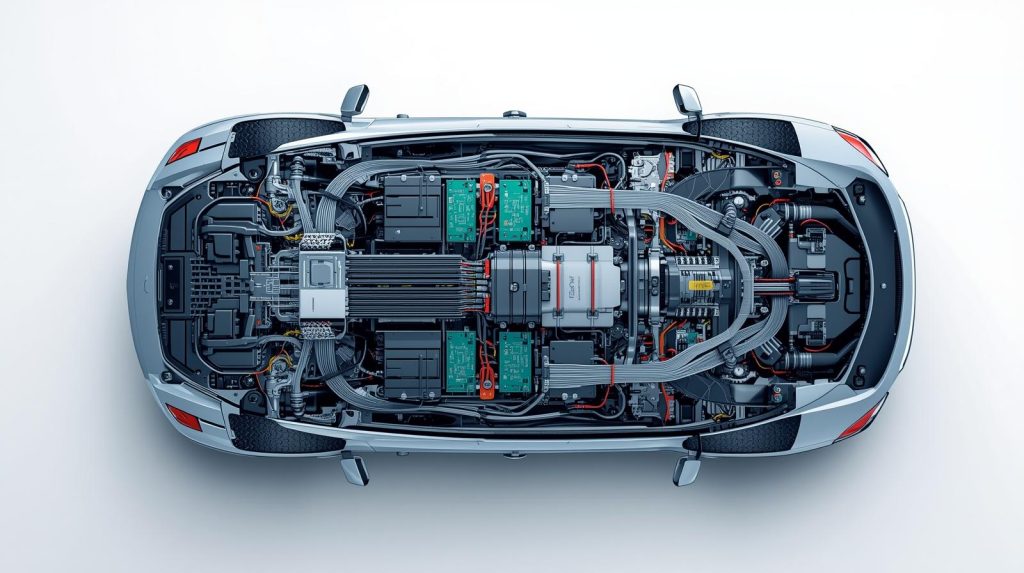
To fully understand why DC to DC converter is essential in electric vehicles, we must first examine how an EV’s electrical system is structured.
High-Voltage System in EVs
Electric vehicles rely on a high-voltage traction battery, typically operating at:
- 400V in most standard EVs
- 800V in high-performance and fast-charging models
This high-voltage system powers:
- The electric motor
- Inverter and drivetrain
- High-power climate control systems
- Fast charging and regenerative braking
While this voltage is ideal for propulsion and efficiency, it is far too high for standard automotive electronics.
Low-Voltage System in EVs
Despite being electric, EVs still rely on low-voltage systems, usually:
- 12V (most common)
- 48V (in newer architectures)
These systems power:
- Headlights and exterior lighting
- Infotainment and navigation
- Power windows and seats
- Sensors, ECUs, and safety systems
- Airbags, ABS, and braking electronics
This dual-voltage architecture is the reason why DC to DC converter is essential in electric vehicles.
What Is a DC to DC Converter in Electric Vehicles?
A DC to DC converter is an electronic power device that converts one DC voltage level to another DC voltage level efficiently and safely.
In electric vehicles, it typically:
- Converts high-voltage DC (400V–800V)
- Into low-voltage DC (12V or 48V)
Unlike internal combustion vehicles that use an alternator, EVs rely entirely on DC to DC converters for low-voltage power generation.
Why DC to DC Converter Is Essential in Electric Vehicles
1. Replacing the Alternator in EVs
Traditional gasoline vehicles use an alternator powered by the engine to generate 12V electricity. EVs do not have engines—making alternators obsolete.
This is one of the most fundamental reasons why DC to DC converter is essential in electric vehicles. The converter:
- Takes power from the high-voltage battery
- Supplies consistent low-voltage power
- Charges the auxiliary 12V battery
Without a DC to DC converter, EVs would have no reliable way to power basic vehicle electronics.
2. Powering Critical Vehicle Electronics
Every electric vehicle depends on dozens of electronic systems working together seamlessly. The DC to DC converter ensures stable voltage for:
- Control units (ECUs)
- Sensors and cameras
- Advanced driver-assistance systems (ADAS)
- Infotainment and displays
Even a slight voltage fluctuation can disrupt these systems. This reliability requirement explains why DC to DC converter is essential in electric vehicles from both performance and safety perspectives.
3. Supporting Vehicle Safety Systems
Safety systems in EVs require uninterrupted power, including:
- Anti-lock braking systems (ABS)
- Electronic stability control (ESC)
- Airbag deployment systems
- Collision avoidance sensors
The DC to DC converter ensures these systems remain operational even during:
- Sudden acceleration
- Regenerative braking
- High-load driving conditions
This safety-critical role further reinforces why DC to DC converter is essential in electric vehicles.
How a DC to DC Converter Works in an EV
Understanding the operation helps clarify why DC to DC converter is essential in electric vehicles.
Step-by-Step Operation
- Input Power
High-voltage DC power is drawn from the main traction battery. - Switching and Regulation
Power electronics rapidly switch current using semiconductor devices. - Voltage Transformation
Inductors or transformers reduce voltage levels. - Filtering and Stabilization
Output voltage is smoothed to eliminate ripples. - Low-Voltage Output
Stable 12V or 48V power is delivered to vehicle systems.
This process occurs continuously while the vehicle is operating.
Efficiency and Energy Optimization
Improving Overall Vehicle Efficiency
Energy efficiency is a major reason why DC to DC converter is essential in electric vehicles. Modern converters achieve efficiencies above 95%, meaning:
- Minimal energy loss
- Reduced heat generation
- Extended driving range
Poor voltage conversion would drain the battery faster, reducing overall EV performance.
Enabling Regenerative Braking Integration
During regenerative braking:
- Energy flows back into the high-voltage battery
- Low-voltage systems must remain stable
Advanced DC to DC converters adjust dynamically to these changes, maintaining consistent power delivery.
Supporting Auxiliary Battery Management
Most EVs still use a 12V auxiliary battery for:
- System startup
- Backup power
- Emergency operations
The DC to DC converter:
- Charges the 12V battery
- Prevents overcharging
- Maintains battery health
This function alone explains why DC to DC converter is essential in electric vehicles, especially during long-term parking or cold conditions.
Electrical Isolation and Safety
Protecting Passengers and Components
High-voltage systems pose serious safety risks. DC to DC converters provide:
- Electrical isolation
- Surge protection
- Short-circuit prevention
This isolation ensures that low-voltage systems remain safe for passengers and technicians.
Compliance with Automotive Safety Standards
DC to DC converters are designed to meet strict standards such as:
- ISO 26262 (functional safety)
- Automotive EMC regulations
Meeting these standards is another reason why DC to DC converter is essential in electric vehicles.
Role in Modern EV Technologies
Enabling Advanced Driver Assistance Systems (ADAS)
ADAS features rely on:
- Cameras
- Radar
- LiDAR
- High-performance processors
These systems require clean, stable low-voltage power—delivered by the DC to DC converter.
Supporting Connectivity and Infotainment
From GPS navigation to over-the-air updates, modern EVs are highly connected machines. DC to DC converters ensure:
- Stable voltage for communication modules
- Reliable infotainment performance
- Continuous system uptime
Bidirectional DC to DC Converters and the Future of EVs
Vehicle-to-Load (V2L)
Some EVs can power external devices. DC to DC converters make this possible by:
- Managing power flow
- Maintaining voltage stability
Vehicle-to-Grid (V2G)
Bidirectional DC to DC converters enable EVs to:
- Supply electricity back to the grid
- Act as mobile energy storage systems
This evolving capability highlights why DC to DC converter is essential in electric vehicles not just today, but in the future energy ecosystem.
DC to DC Converter vs Onboard Charger
| Feature | DC to DC Converter | Onboard Charger |
|---|---|---|
| Primary Role | Voltage conversion | Battery charging |
| Power Source | High-voltage battery | External AC supply |
| Output | 12V or 48V | High-voltage DC |
| Operation | Continuous | During charging |
Both are important, but serve entirely different purposes.
Maintenance and Reliability
DC to DC converters:
- Have no moving parts
- Require minimal maintenance
- Are designed to last the vehicle’s lifetime
Their durability contributes to overall EV reliability.
Environmental and Sustainability Benefits
By maximizing efficiency and reducing energy waste, DC to DC converters:
- Improve driving range
- Reduce battery strain
- Lower overall environmental impact
This aligns with the sustainability goals of electric mobility.
Challenges and Limitations
While essential, DC to DC converters face challenges:
- Thermal management
- High-power density demands
- Cost optimization
Ongoing innovation continues to address these issues.
Without DC to DC converters, modern electric vehicles simply could not function.
Conclusion
The DC to DC converter may not be the most visible EV component, but it is undeniably one of the most important. From powering safety systems to enabling future energy-sharing technologies, its role is foundational.
As electric vehicles continue to evolve, the importance of this component will only grow—proving once again why DC to DC converter is essential in electric vehicles today and for decades to come.
Frequently Asked Questions (FAQs)
1. Why DC to DC converter is essential in electric vehicles?
A DC to DC converter is essential in electric vehicles because it converts high-voltage battery power into low-voltage electricity needed for electronics and safety systems.
2. What role does a DC to DC converter play in EVs?
The DC to DC converter supplies stable 12V or 48V power to vehicle electronics and replaces the alternator found in traditional fuel vehicles.
3. How does a DC to DC converter improve EV safety?
It ensures consistent power to braking systems, airbags, sensors, and control units while providing electrical isolation from high-voltage components.
4. Does an electric vehicle need a 12V battery if it has a DC to DC converter?
Yes, EVs still use a 12V battery, and the DC to DC converter keeps it charged and supplies backup power when needed.
5. Can an EV operate without a DC to DC converter?
No, without a DC to DC converter, essential low-voltage systems would not function, making the vehicle unsafe and inoperable.
6. Is a DC to DC converter the same as an onboard charger?
No, a DC to DC converter manages voltage levels within the vehicle, while an onboard charger converts external AC power to charge the EV battery.
7. How efficient are DC to DC converters in electric vehicles?
Modern EV DC to DC converters are highly efficient, typically operating at over 95% efficiency to minimize energy loss.
8. Do DC to DC converters support regenerative braking?
Yes, they adapt to changing power flows during regenerative braking and maintain stable voltage for low-voltage systems.